
AI SOC Analyst Agent: A Cybersecurity Capstone Project

Table Of Content
- 🤖 AI SOC Analyst Agent: A Cybersecurity Capstone Project
- Introduction
- 🎯 Project Goal
- 🏗️ High-Level Architecture
- 🔎 Example Investigation Workflow
- 🛡️ Security Enhancements and Refactoring
- 1️⃣ Environment Variable Support
- 2️⃣ Investigation Scope Controls
- Time Window Guardrails
- Row-Limiting Controls
- 3️⃣ Sensitive Data Redaction
- 4️⃣ Security Guardrails
- 5️⃣ Human-in-the-Loop Remediation
- 🚨 Example Findings
- 💼 Why This Matters
- 📚 What This Project Taught Me
- 🎓 Why I Consider This a Capstone Project
- Cybersecurity
- Cloud Security
- AI
- Governance & Risk
- Technical Skills
- 🚀 What's Next?
- Final Thoughts
- 🔗 Project Link
🤖 AI SOC Analyst Agent: A Cybersecurity Capstone Project
Introduction
Over the past year, I have been building knowledge and hands-on experience across cybersecurity, cloud security, threat hunting, governance, risk management, and AI-assisted security operations.
One of my final projects during my Cyber Range training experience was the development and refinement of an AI SOC Analyst Agent - a Python-based application that combines Azure Log Analytics, Microsoft Defender for Endpoint (MDE), and OpenAI to support threat hunting and security investigations.
While the original project began as a guided training exercise, I wanted to take it further by refactoring the code, adding additional security controls, improving documentation, and making it suitable as a public portfolio project.
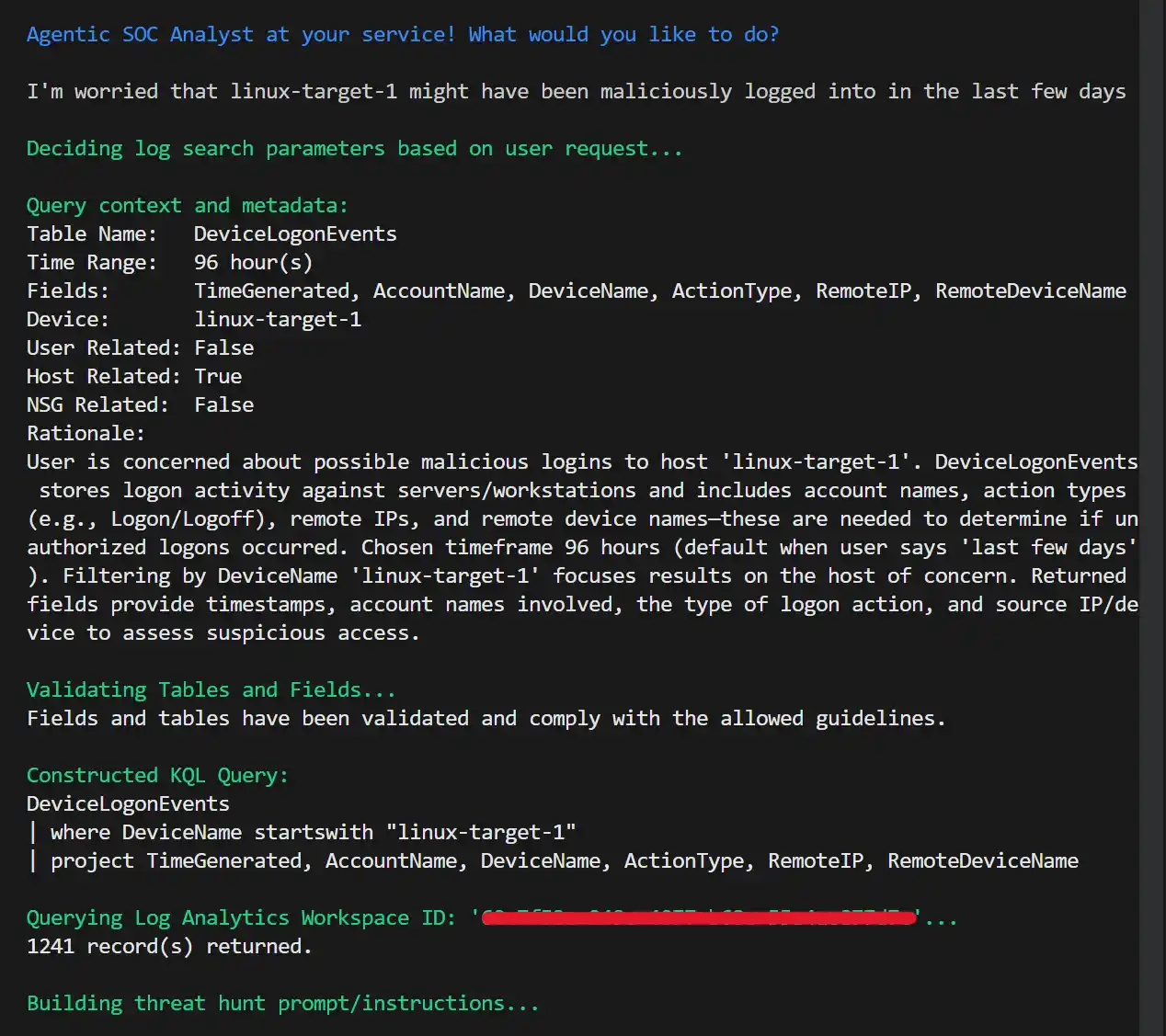
🎯 Project Goal
Security analysts are often required to investigate large volumes of telemetry spread across multiple systems.
The objective of this project was to explore how an AI-assisted workflow could help:
- Interpret natural-language investigation requests
- Select appropriate telemetry sources
- Query Azure Log Analytics
- Analyze security events
- Identify suspicious activity
- Map findings to MITRE ATT&CK
- Generate investigation recommendations
The goal was never to replace human analysts.
Instead, the goal was to accelerate investigation workflows while maintaining analyst oversight and decision-making.
🏗️ High-Level Architecture
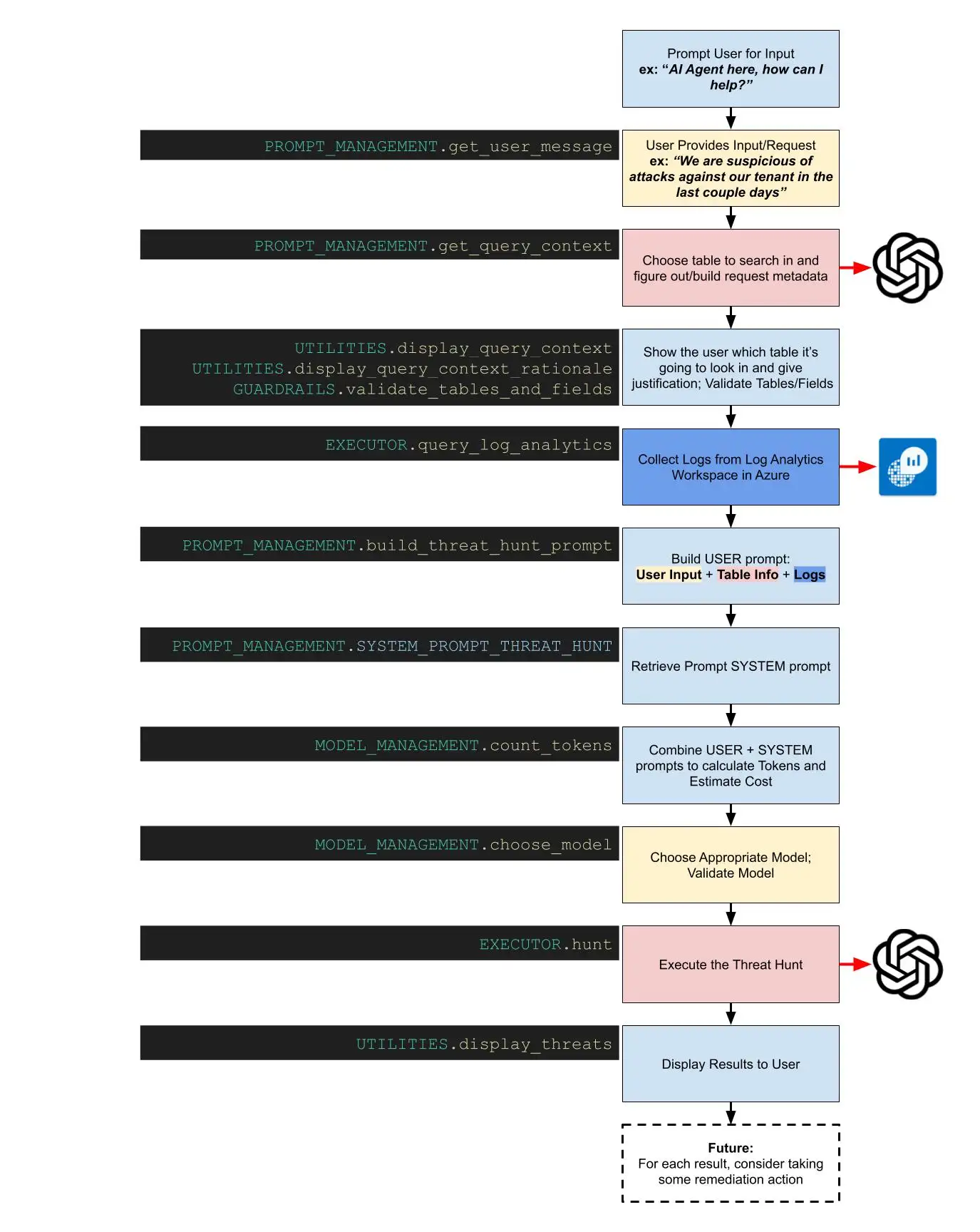
The project uses:
- Python
- Azure Log Analytics
- Microsoft Defender for Endpoint
- Azure Identity
- Kusto Query Language (KQL)
- OpenAI API
- MITRE ATT&CK
Additional architecture diagrams, workflow documentation, and guardrail design notes are available in the project's GitHub repository under the /docs folder on my GitHub.
🔎 Example Investigation Workflow
An analyst can submit a request such as:
I'm concerned that a Linux server may have been compromised over the last few days.
The agent then:
- Determines the most relevant telemetry source
- Selects appropriate fields
- Generates a KQL query
- Retrieves logs from Azure Log Analytics
- Sends the data to OpenAI for analysis
- Identifies suspicious activity
- Maps findings to MITRE ATT&CK
- Produces investigation recommendations
The resulting findings can then be reviewed by the analyst before any action is taken.
🛡️ Security Enhancements and Refactoring
The original AI SOC Agent was introduced as part of a cybersecurity training program. Rather than treating it as a completed exercise, I used the project as an opportunity to review the design, refactor the implementation, and prepare it for public release as a portfolio artifact.
The enhancements focused on improving security, operational safety, configuration management, and maintainability. The following sections highlight some of the key changes that were introduced during the refactoring process.
1️⃣ Environment Variable Support
The original implementation relied on direct configuration values.
The refactored version introduces:
- Environment-variable support
- Secret-safe GitHub publication
.env.example- Improved configuration hygiene
This allows the repository to be published publicly without exposing sensitive information.
2️⃣ Investigation Scope Controls
Time Window Guardrails
Large investigation windows can generate excessive data and significantly increase token consumption.
To address this, I implemented maximum lookback periods for each telemetry source.
Examples include:
| Table | Maximum Lookback |
|---|---|
| DeviceProcessEvents | 24 Hours |
| DeviceNetworkEvents | 24 Hours |
| DeviceLogonEvents | 96 Hours |
| AzureActivity | 168 Hours |
| SigninLogs | 168 Hours |
This helps prevent excessive log collection while keeping investigations focused.
Row-Limiting Controls
Another improvement was the introduction of log truncation controls.
The platform now limits AI analysis to:
500 rowsbefore telemetry is submitted to the model.
Benefits include:
- Reduced token consumption
- Lower API costs
- Faster processing
- Improved stability
3️⃣ Sensitive Data Redaction
One of the most important additions involved protecting sensitive information before submission to the LLM.
The refactored version now sanitizes:
- IP addresses
- Email addresses
- Azure GUIDs
before data is sent for analysis.
This helps reduce the risk of unnecessary exposure of sensitive information.
4️⃣ Security Guardrails
Additional validation controls were added including:
- Table allowlists
- Field allowlists
- Model allowlists
- Guardrail reporting
These controls help ensure investigations remain within approved boundaries.
5️⃣ Human-in-the-Loop Remediation
Potential response actions such as endpoint isolation require explicit analyst approval.
No remediation action occurs automatically.
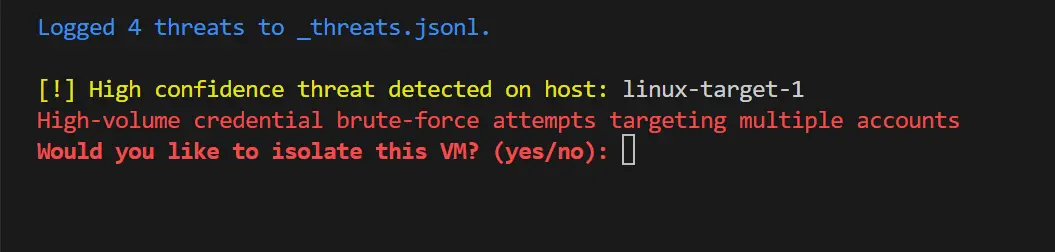
This aligns with an important principle in security operations:
Automation should assist analysts, not replace them.
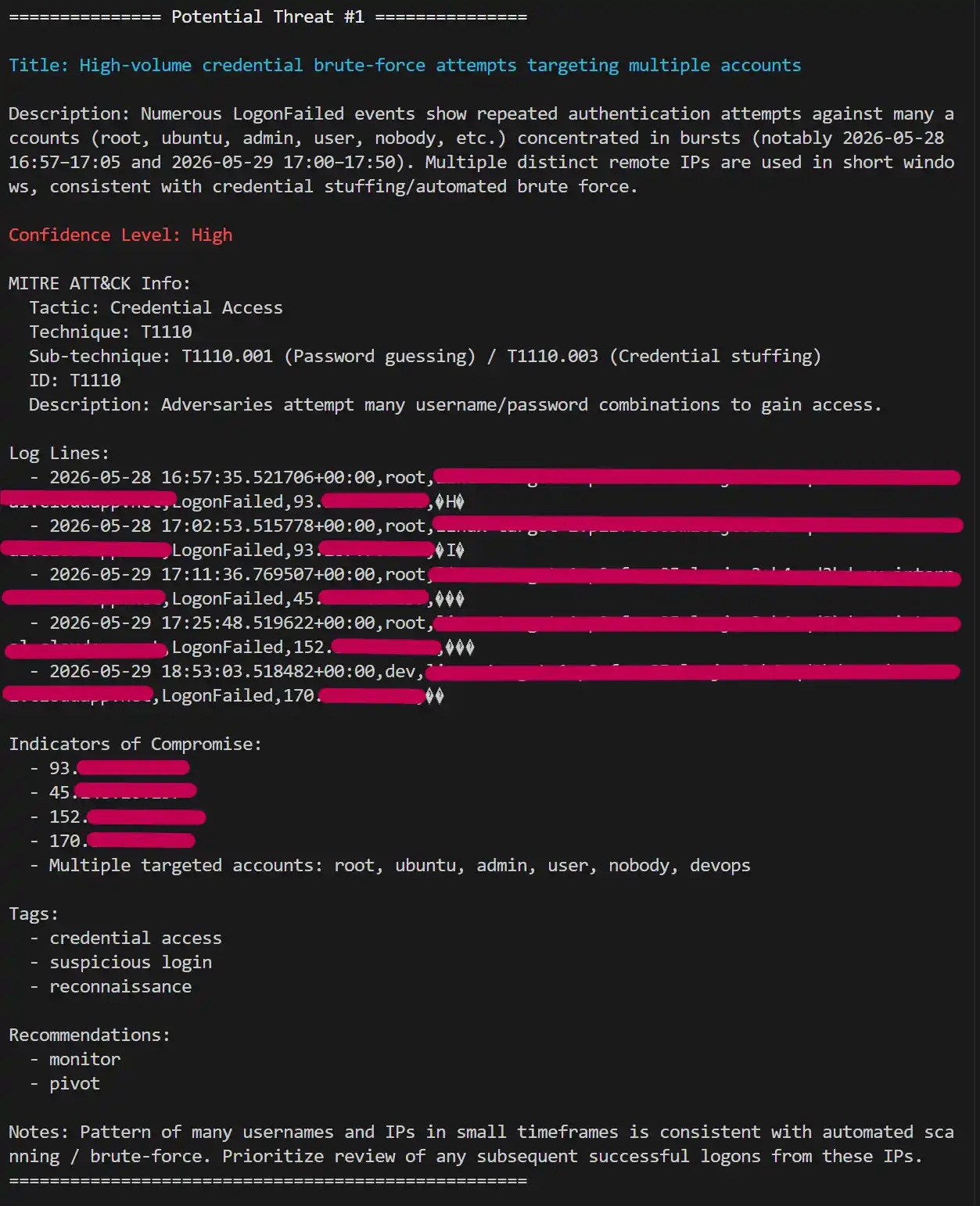
🚨 Example Findings
These findings were generated from Azure telemetry and enriched with confidence levels, MITRE ATT&CK mappings, and analyst recommendations.
- Credential stuffing attempts
- Suspicious root logins
- Service account credential probing
- SSH enumeration activity
💼 Why This Matters
Beyond the technical implementation, the project explores a question many security teams are beginning to face:
How can AI assist security operations while remaining secure, transparent, and governed?
The answer is not simply connecting an LLM to security logs. Effective AI-assisted workflows require controls around data access, scope, validation, privacy, cost management, and analyst oversight.
The guardrails added during refactoring were designed with these considerations in mind.
📚 What This Project Taught Me
The technical aspects were valuable, but the most important lesson was something broader.
Building AI-assisted security tooling is not simply about connecting an LLM to security logs.
The challenge is building appropriate controls around that capability.
This project reinforced the importance of:
- Security guardrails
- Governance
- Data protection
- Validation
- Human oversight
- Risk management
Ironically, many of these concepts closely mirror principles I used earlier in my career while working in risk management and governance roles.
🎓 Why I Consider This a Capstone Project
Looking back over the past year, this project brought together many of the skills I have been developing:
Cybersecurity
- CompTIA Security+
- ISC2 CC
- Microsoft SC-900
- Threat hunting
- Incident analysis
Cloud Security
- Azure
- Microsoft Defender for Endpoint
- Microsoft Sentinel
- Log Analytics
- KQL
AI
- OpenAI integration
- Prompt engineering
- AI-assisted investigations
Governance & Risk
- Security controls
- Validation
- Guardrails
- Human approval workflows
Technical Skills
- Python
- Refactoring
- Documentation
- GitHub publication
Rather than representing a single technology, this project serves as a practical integration of everything I have learned so far.
For that reason, I view it as a personal cybersecurity capstone project.
🚀 What's Next?
While this project marks an important milestone, there is still much to learn.
Potential future enhancements include:
- Threat intelligence enrichment
- IOC reputation lookups
- Investigation timeline reconstruction
- Multi-agent orchestration
As AI continues to evolve, I believe one of the most interesting areas will be understanding how AI can responsibly augment security operations while maintaining strong governance and oversight.
Final Thoughts
This project represents an important milestone in my cybersecurity journey. It brought together many of the concepts I have been developing over the past year, including cloud security, threat hunting, AI-assisted analysis, governance, and risk management.
Most importantly, it reinforced a lesson that applies far beyond cybersecurity:
Powerful technology is only as effective as the controls and judgment surrounding its use.
🔗 Project Link
🔗 Supporting files and a more in-depth technical report are available on GitHub
Thanks for reading! 🙏
If you're interested in technology risk, security governance, or enterprise security operations, feel free to connect with me on LinkedIn.
Feel free to reach out with questions or thoughts.