
Building an ISO 27001 Risk Register: A Practical Exercise in Seeing Risk Clearly

Understanding risk is one of the core skills in cybersecurity.
ISO/IEC 27001 provides a formal framework for assessing, prioritizing, and treating risks - but the real value comes from practicing how these concepts work in context.
After passing the JLPT N2 earlier this year, I began my cybersecurity journey with a focus on foundations. One of the most meaningful exercises from my ISO 27001 studies was building a Risk Register from scratch.
🌐 What Is a Risk Register?
A Risk Register is a structured document used to:
- Identify assets and threats
- Estimate likelihood and impact
- Map risks to existing or needed controls
- Prioritize treatment actions
- Track progress over time
It turns abstract standards into an actionable view of what actually matters to an organization.
🛠️ How I Built My Example Register
To internalize the concepts, I created a simplified scenario and applied the ISO 27001 methodology:
- Defined Assets - endpoints, credentials, cloud services, and internal data
- Identified Threats & Vulnerabilities - unauthorized access, misconfiguration, weak passwords, data exposure
- Evaluated Risk Levels - using a simple 1-5 likelihood/impact scale
- Mapped Applicable Controls - referencing Annex A (e.g., A.5.1, A.8.3, A.8.16)
- Assigned Treatment Options - mitigate, transfer, avoid, or accept
- Noted Residual Risk - what remains after controls are applied
This helped me practice “thinking like a risk analyst” - understanding how security decisions flow from visibility, context, and prioritization.
📊 Example Risk Register Table
Below is a shortened example of how the data is structured. The example is based on a fictional school environment.
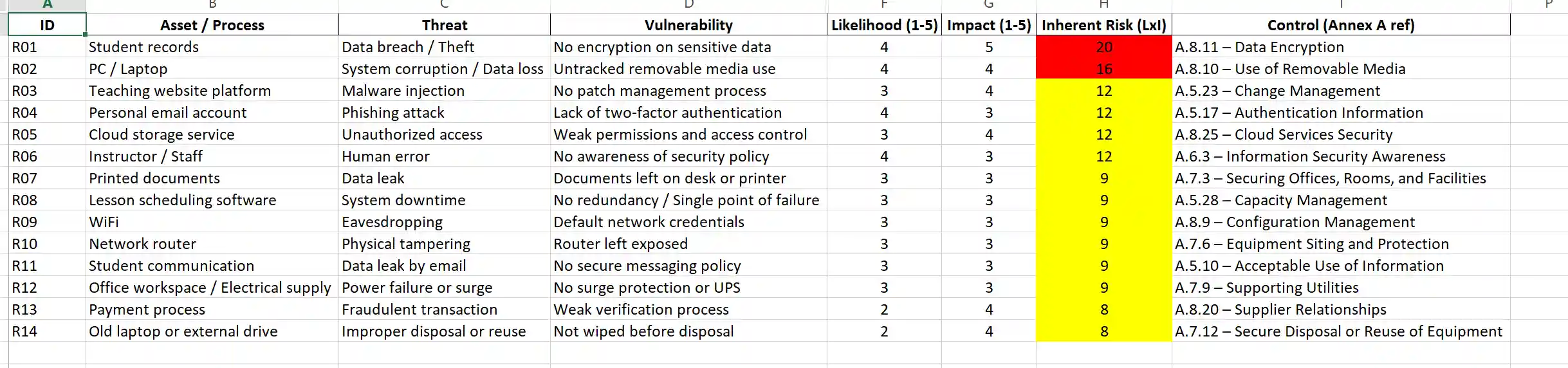
Download the full version below. ⬇️
📥 Download the Full Register
You can download the file here:
👉 ISO 27001 Risk Register (Excel)
👉 ISO 27001 Risk Register (PDF)
🎯 Key Takeaways
Working through this exercise deepened my understanding of:
- How risks interact with business context
- Why control selection must be purposeful
- The balance between likelihood and impact
- The importance of clear communication in security management
Security, much like photography, relies on perspective.
The more sharply we see details - and the more clearly we frame them - the better we can understand the whole picture.
🔗 Full report and supporting files available on GitHub
Thanks for reading! 🙏
If you're studying ISO 27001 or building foundational risk skills, I hope this example is helpful.
If you're interested in security governance, GRC frameworks, or enterprise risk programs - feel free to connect with me on LinkedIn.
Feel free to reach out with questions or thoughts.